


Cloud data security is the practice of protecting cloud-hosted data from unauthorized access, alteration, loss, and misuse while keeping current evidence that each control covers the right data copy. Its scope includes data at rest, in transit, and in use across IaaS, PaaS, SaaS, hybrid, and multicloud services.
The difficult work begins after encryption and backups are enabled. A production database feeds analytics, creates snapshots, crosses APIs, and inherits access from several identities. Each copy can have a different owner, key, retention rule, and control result.
Data security in the cloud fails when those copies lose their owner, control result, or evidence timestamp. Static control lists rarely preserve that continuity.
The practical problem connecting data security and cloud computing is continuity. This guide follows one example data store from scoping through remediation and independent retesting. It also separates provider operation from customer configuration across the shared-responsibility boundary.
Key insights
Five conclusions shape the operating model used throughout this guide.
- Cloud data security covers confidentiality, integrity, availability, privacy risk, and lifecycle handling for every required data copy.
- Provider responsibility expands from IaaS to SaaS. Customer ownership of data, access, configuration, and evidence does not disappear.
- Encryption proves one condition. Identities, copies, network paths, retention, recovery, and current evaluations determine verified coverage.
- A pass rate needs a denominator and evidence window. Missing evaluations are coverage gaps, not silent passes.
- Cloudaware can connect supported asset context with policy results, owners, exceptions, tickets, and evaluation history. Native tools still enforce controls.
How this guide was developed: The operating model maps current NIST, CIS, CSA, AWS, Microsoft Azure, and Google Cloud guidance to one traceable control record. Cloudaware passages use current official product pages and supplied product materials. The database, resource IDs, tickets, timelines, control results, and service-level targets in the running example are fictional and do not describe a customer deployment.
What is cloud data security, and where does its scope begin and end?
Cloud data security protects every data copy wherever it is stored, moved, processed, backed up, exported, or deleted. If the security record covers only the primary database, its scope is incomplete.
NIST FIPS 199 defines confidentiality, integrity, and availability as security objectives. The NIST Privacy Framework adds a separate privacy-risk lens. Together, they create four operating questions:
- Confidentiality: Who can read or decrypt this copy?
- Integrity: Who changed it, and was the change authorized?
- Availability: Can its owner restore usable data within the approved target?
- Privacy: May this copy exist here, for this purpose, and for this duration?
One control can pass while another fails. Encryption may be enabled while a broad identity can decrypt the records. A backup may exist while its restore test is stale. Retention may also preserve personal data beyond its approved purpose.
Deployment changes the responsibility boundary, not those outcomes. The CSA Cloud Controls Matrix assigns control responsibilities by actor. Provider-specific maps remain necessary because services, regions, features, and contracts differ.
Consider a dataset stored in a managed production database, replicated to object storage, and exported to SaaS analytics. Record sensitivity, owner, access path, key, retention, recovery target, and evidence time for each location.
If the analytics copy lacks an owner or current access result, exclude it from verified coverage. The primary database cannot lend that copy a passing result.
| Related term | Operating focus | Evidence that answers it |
|---|---|---|
| Cloud data security | Data copies, access paths, lifecycle, ownership, and control state | Classified resource, owner, access result, key setting, exception, recovery test, and current evaluation |
| Cloud security | Identities, workloads, networks, APIs, configurations, and management planes | IAM review, posture finding, network policy, workload alert, configuration history, and remediation record |
| Cloud data protection | Safeguards against disclosure, alteration, deletion, loss, or failed recovery | Encryption, DLP result, backup state, restore test, retention record, and deletion evidence |
| Data privacy | Permitted collection, use, location, sharing, retention, and deletion | Processing purpose, transfer record, retention schedule, and deletion proof |
These categories overlap, but their evidence is not interchangeable. A cloud security controls catalog can define safeguards without proving that one database passed its latest evaluation.
For permitted purpose, residency, retention, or deletion, read our data security and privacy in cloud computing guide. For recurring failure patterns, see cloud data security challenges. The cloud data security best practices article covers implementation sequence. This guide focuses on the operating model: responsibility, controls, and proof of closure.
Operationally, the output is a traceable record of the control, owner, result, exception state, and evidence time.
Responsibility changes by service model and control
Responsibility shifts as providers operate more of the stack from IaaS to PaaS and SaaS. Customers still govern their data, identities, tenant configurations, retention, and evidence.
Microsoft Azure keeps customer data, identities, configurations, and access management within the customer boundary. AWS ties customer responsibility to the selected services, regions, integrations, and requirements. Google Cloud adds shared fate while retaining customer workload and data responsibilities.
Use these models as scoping baselines, not substitutes for the contract. Verify every assignment against the selected service, enabled features, region, and current provider documentation.
Before assigning a control, answer three questions:
- Who operates the underlying layer?
- Who configures or approves the control?
- Who retains evidence and accepts the result?
| Service model | Provider typically operates | Customer configures or governs | Evidence the customer still needs |
|---|---|---|---|
| IaaS | Facilities, hosts, physical networking, storage infrastructure, and hypervisor | Guest OS, applications, tenant networking, identities, keys, classification, backups, and retention | Asset owner, patch state, IAM and network settings, key configuration, logs, backup state, and restore result |
| PaaS | IaaS layers, OS, runtime, middleware, managed-service software, and platform patching | Deployed code, service settings, identities, exposure, data, keys, retention, and recovery options | Configuration, access review, deployment history, key use, classification, backup, restore, and retention results |
| SaaS | Application stack, platform, infrastructure, and service maintenance | Tenant settings, users, roles, sharing, connectors, retention, export, and deletion | Provider assurance, tenant configuration, role review, audit logs, connector inventory, retention, export, and deletion records |
Provider operation expands, but customer evidence ownership remains. Take the managed PaaS database in this example. The provider patches its managed platform. The customer controls identities, keys, exposure, retention, and recovery settings. Its evidence package combines provider assurance with configuration, access, key-use, and restore records.
Suppose the restore test falls outside the approved window. The architect marks recovery unverified and assigns a retest. Coverage returns only after the new result meets the recovery target.
Managed backup still leaves retention approval and restore validation with the customer under the selected service terms. Every control needs an operator, customer owner, evidence source, review window, and acceptance rule.
The components of cloud data security form one control system
Cloud data security works only when data context, protection controls, and operating evidence stay connected. A store may pass today and become unverified when its evidence expires or its data path changes.
The next three sections return to the production database and analytics copy described above. The control loop shows how each stage supplies the next decision.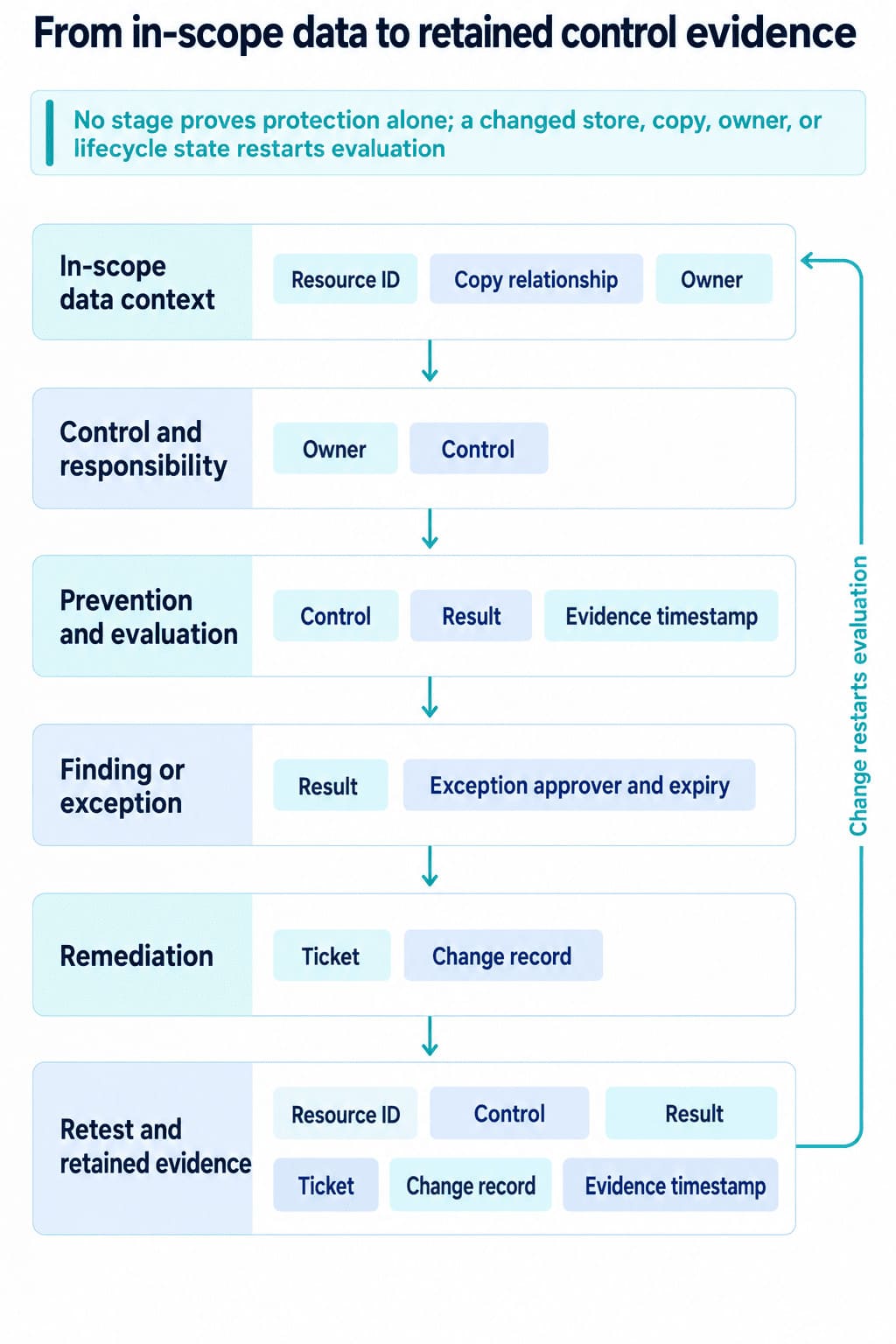 A control remains defensible only while every handoff preserves scope, ownership, and current evidence.
Cloud data security controls and technologies by job
The operating gap is usually between systems: DSPM records classification, IAM and CIEM expose access conditions, CSPM detects failed configurations, and ITSM tracks remediation.
Unless the records share the data-copy identifier and evaluation window, the team cannot demonstrate control closure. Match each control job to its required evidence and system boundary:
| Control job | Primary systems | Inspectable evidence | Boundary |
|---|---|---|---|
| Discover and classify | DSPM, DLP, provider classification services, CMDB context | Store or copy ID, sensitivity, location, owner, lineage, timestamp | CMDB supplies asset context. Content classification must come from DSPM, DLP, or a native source. |
| Govern access and keys | IAM, CIEM, KMS, HSM | Effective principals, inherited access, key policy, usage and rotation evidence | A role inventory alone does not prove effective access. |
| Protect movement and use | TLS, tokenization, masking, DLP, network controls | Endpoint or path, TLS state, transfer result, DLP result | Encryption does not prove permitted use. |
| Detect drift and exposure | CSPM, CNAPP, provider configuration checks, SIEM | Resource condition, rule version, source time, evaluation time | The source system produces the finding. A separate workflow may remediate it. |
| Retain, recover, and delete | Backup and recovery, lifecycle and retention controls | Restore result, achieved RPO/RTO, retention state, deletion evidence | A backup-enabled flag does not prove usable recovery. |
| Route and verify closure | ITSM, CMDB, compliance evidence | Owner, SLA, exception, change record, passing retest | Ticket closure does not prove control closure. |
Start with the resource or data-copy identifier, not the vendor. Carry it through the classification result, policy finding, ticket, change, and retest. A connector can move context; it cannot manufacture evidence that the source system never produced.
Data context: inventory, classification, ownership, and lifecycle
Define the population before evaluating the control. Include primary stores, replicas, snapshots, exports, streams, backups, and SaaS repositories. Document the paths between them, because protection often changes at the copy boundary.
CIS Controls v8.1 Control 3 covers data management, inventory, classification, flows, retention, and disposal. Translate that model into one record per object or copy:
- Identity and scope: Resource ID, CI Class, cloud account, subscription or project, discovery source, and last-observed time.
- Business context: Purpose, application, environment, and accountable owner.
- Data context: Sensitivity, classification source, copy relationship, region, and processing path.
- Lifecycle: Retention rule, state, disposal method, and last control evaluation.
In this example, the billing database holds restricted customer data under a seven-year retention rule. Its fraud-reporting analytics export expires after 30 days. A missing lineage link or owner prevents that export from inheriting the database result.
“A 95% pass rate is not decision-ready until we know which data copies were expected, which were evaluated, and which were missed.”


Record discovery and evaluation times separately, since current inventory can contain stale control results.
Exclude retired resources only through an approved lifecycle rule. Report unsupported resources as coverage gaps. CMDB records can supply resource context and relationships. Use DSPM, DLP, or imported classification data for sensitive-content context.
Protection controls: identity, encryption, network paths, and posture
Encryption is a condition, not a verdict. Open the key policy and list every human or workload identity that can decrypt the database.
NIST SP 800-53 Rev. 5 separates access, cryptographic, network, audit, configuration, and recovery safeguards across control families. Test those paths separately:
- List identities with read, decrypt, export, or administrative rights. Inspect least privilege, MFA, and the effective key policy.
- Trace TLS termination, temporary storage, exports, and destinations. Check masking, tokenization, and DLP requirements.
- Inspect endpoints, network rules, egress, logs, backups, and deletion settings. Evaluate exact resources for drift.
- Test deletion protection, an immutable recovery copy, and the break-glass path. Confirm the application role cannot delete recovery data.
Record the key owner, decrypting principals, plaintext locations, key-use logging, and latest rotation test. Add the evaluated resource ID and evidence timestamp. A copy using another key or identity path needs a separate result.
In the example control check, the database passes while its analytics copy fails the public-access rule. The architect removes that copy from verified coverage and closes the endpoint. Encryption can pass while the data path fails. Coverage returns only after the same copy passes a new check.
Proof and response: logs, exceptions, remediation, and recovery evidence
A finding needs history, an owner, and a passing retest. Before remediation, record the object, rule, condition, run ID, detection time, and source timestamp. The NIST Cybersecurity Framework 2.0 spans Govern, Identify, Protect, Detect, Respond, and Recover. Carry the record through three evidence states:
- Detection: Failed condition, sensitivity, rule version, and raw log reference.
- Decision: Owner, SLA, ticket, or a time-boxed exception with approver and compensating control.
- Closure: Change record, remediation time, run history, passing retest, and new evidence timestamp.
The failed analytics copy receives an owner, due date, and temporary exception. After the endpoint closes, the same rule evaluates the same resource again.
The closure rule also applies to recovery. A backup-enabled flag cannot prove restoration. Require a test showing backup integrity and achieved recovery point and recovery time objectives.
Use four metrics to test whether the evidence chain is current:
| Metric | Calculation and cohort | Freshness and action |
|---|---|---|
| Evaluated pass coverage | Current passes divided by expected in-scope evaluations | Recalculate after every run; separate missing evaluations |
| Overdue failed-control rate | Open failures past SLA divided by all open failures | Refresh daily; escalate by owner and age |
| Expired-exception count | Expired exceptions on unresolved controls | Refresh daily; reapprove, remediate, or remove |
| Median failed-to-retest time | Median days from failure to passing retest across verified closures | Report weekly with cohort size; split by control or owner |
Together, these metrics expose missing evaluations, overdue failures, stale exceptions, and slow verification.
How data security in cloud computing works from discovery to verified closure
Start with one in-scope store. Finish with a current result that a reviewer can trace back to that store.
The handoff fails if any artifact loses the resource ID, owner, control, or timestamp. Broader rollout and cadence belong in the cloud data security best-practices playbook.
Map the data and the responsibility boundary
Freeze the in-scope population for an approved evidence window. Create one control record for each store and downstream copy.
Example control record for db-prod-billing-01:
| Control-record field | Example value |
|---|---|
| Scope | Managed PostgreSQL; Provider A; production subscription; EU region |
| Business context | Restricted customer data; Billing application; owner: Billing service owner |
| Data flow | Primary database to analytics-export-01; 30-day retention; separate result required |
| Control objective | Public access disabled; access limited to approved workloads |
| Responsibility | Provider patches the platform; customer configures identity, network, and key controls |
| Owners | Cloud platform lead; Billing exception approver; cloud security evidence owner |
| Current evidence | Configuration, access review, key-policy result, resource ID, and timestamp within a 24-hour evidence window |
The resource ID binds each finding, exception, ticket, change, and retest to the same object. The flow field prevents the analytics copy from borrowing the database result.
This step passes when a reviewer can name the configurator, risk approver, evidence owner, and current proof. Treat unsupported resources and expired timestamps as scope gaps.
Prevent unsafe change, then detect drift
Preventive controls reject unsafe declared configurations. Detective checks evaluate the live resource after identities or network paths change.
NIST SP 800-53 Rev. 5 separates Configuration Management from Assessment, Authorization, and Monitoring. Keep their outputs separate:
| Control layer | Deployment gate | Live drift check |
|---|---|---|
| Input and action | IaC plan; platform engineer runs policy as code before merge | Provider configuration collected on schedule; architect evaluates the resource |
| Evidence produced | Pipeline result, rule version, commit, and resource ID | Result, failed condition, source timestamp, and last evaluated |
| Failure caught | Unsafe declared configuration | Console edits, new principals, or changed paths |
In this example, the IaC gate blocks public access for analytics-export-01. After release, an administrator adds a principal granting public access in the provider console. The next scheduled hourly CSPM check returns Failed against the same resource ID.
Hourly means scheduled, not real-time. Set the cadence using sensitivity, change frequency, source collection, and ingestion delay. Preserve the rule version, evaluated object, failed condition, source time, and evaluation time.
A clean pipeline cannot prove that a live resource stayed clean.
Route the finding, govern the exception, and retest the control
Before routing, attach enough context to survive every handoff:
- Resource ID, control ID, failed condition, rule version, evaluation time, and finding age.
- Application, environment, classification, current owner, and source-system link.
- Priority, SLA, work item, exception status, and due date.
The owner has two legitimate paths:
| 1 | 2 |
|---|---|
| Fix now. Change the provider configuration or approved IaC. Attach the actor, timestamp, and change record, then rerun the rule. | Accept temporarily. Record the reason, approver, compensating control, review date, and expiry. Keep the technical result as Failed. |
An approved exception changes risk treatment, not the technical result. Expiry returns the finding to active work.
Example failure-to-retest timeline: **analytics-export-01**
- 10:00: The scheduled check records Failed against the resource and control IDs.
- 10:08: The architect opens JIRA-4821 with the owner, context, finding age, and a 24-hour SLA.
- 10:20: The Billing owner approves a 24-hour exception with private-network access and logging.
- Before expiry, the platform engineer removes the principal in IaC and attaches CHG-2048.
- The next evaluation checks the same resource and rule, then records Passed with a new timestamp.
“Closing the Jira ticket does not close the failed data control. We need a passing retest against the same resource and rule, with fresh evidence.”

For this example, retain JIRA-4821, CHG-2048, the failed run, exception, expiry, and full evaluation history. The change record and independent passing result are both required for verified closure.
Trace a failed data control from resource to verified closure
The operating record often fragments across the provider console, policy engine, CMDB, and ITSM. A cloud security architect needs a single path through scope, ownership, treatment, and verification.
IT Compliance scorecard and findings
Cloudaware IT Compliance scorecard showing storage-encryption policy results and findings
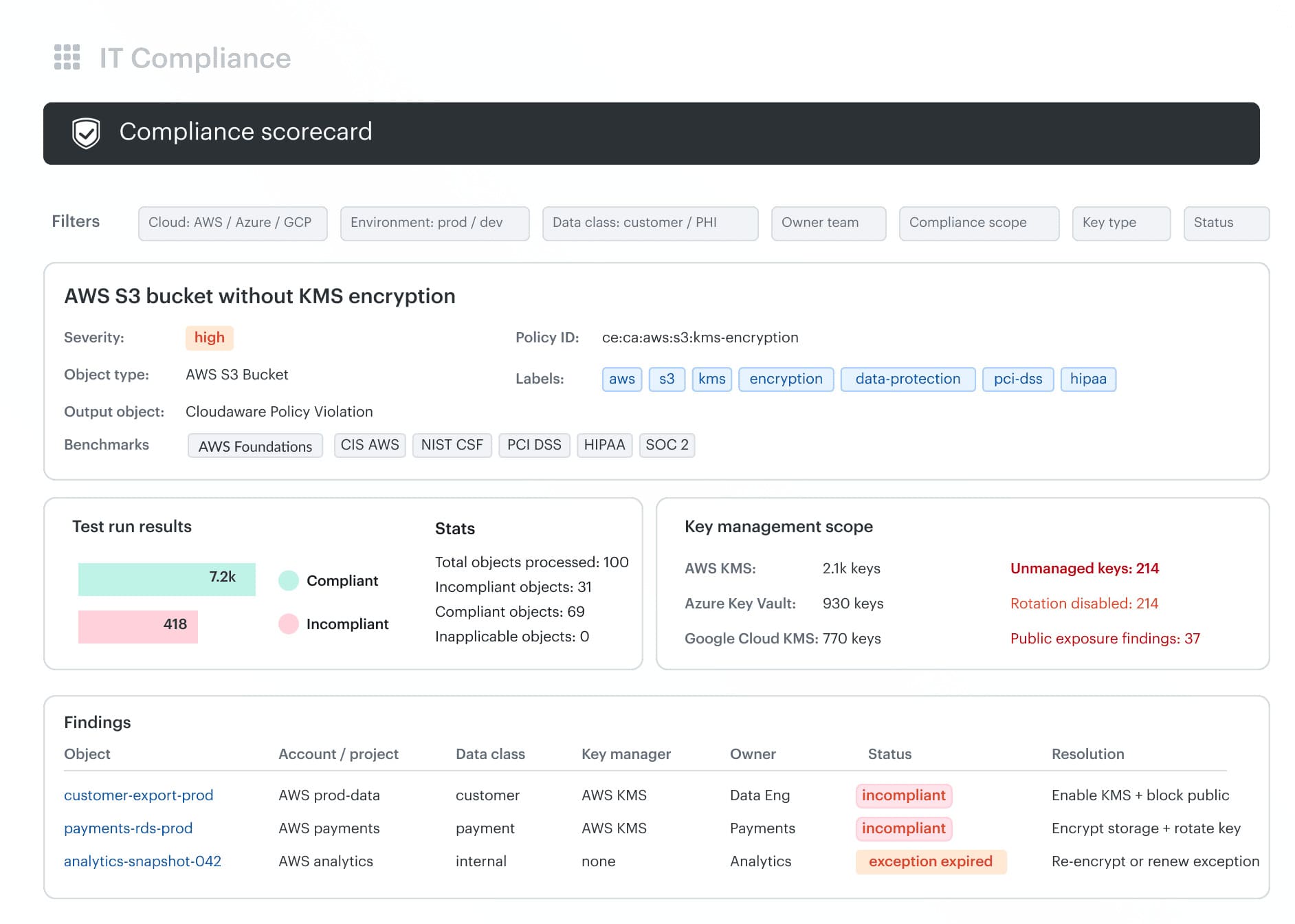
For supported connected sources, Cloudaware IT Compliance relates CMDB context to scheduled policy results, rule findings, exceptions, tickets, and evaluation history. Native IAM, KMS, DLP, CSPM, SIEM, backup, scanner, and ITSM systems still perform their own control functions.
Normalize the resource context before evaluating the control
A policy needs a defensible denominator before its result becomes useful. The right scope is rarely every discovered database.
Cloudaware CMDB normalizes supported provider records into queryable CI populations. Configured relationships to cloud accounts, Azure subscriptions, GCP projects, applications, environments, and owners can then define policy scope.
Check three conditions:
- Population: Required CI Classes, providers, regions, lifecycle states, and collection window are included.
- Business context: Every in-scope resource has a usable application, environment, and current owner.
- Coverage: Missing or unsupported records remain separate from resources the policy can evaluate.
For a customer-managed-key policy, start with production database CIs from configured integrations. Resolve each record to its application and owner. A database missing from the supported population is a coverage gap, not a pass.
Treat sensitivity as source-attributed context. Validate whether it came from a native data-security service, DSPM, DLP, or another configured integration. CMDB scope alone does not prove data classification.