


Public cloud data security is mis-scoped when the deployment model is treated as a footnote. The same control can have a different owner and evidence trail once the provider operates part of the stack. That changes who can prevent exposure and which log proves the fix.
The Flexera 2026 State of the Cloud report found that 51% of enterprise respondents currently have data in public cloud. Architecture is an operating condition, not a hosting label.
This guide turns three realities into working controls: responsibility that shifts by service, API-driven administration, and policy-defined storage exposure. It then shows how to consolidate inventory and posture evidence without flattening provider object models.
For operational depth, use the cloud data security best practices playbook. Across providers, the remaining job is preserving resource, owner, control, exception, and ticket context in one view.
Key insights
- Public cloud data security has three architectural drivers: The responsibility boundary moves by service, administrative change is API-driven, and object-storage exposure changes through mutable policy
- Treat “private by default” as a starting state, not a control guarantee. A later bucket policy, identity grant, access control list, or organization-policy exception can widen access
- Amazon S3, Azure Storage, and Google Cloud Storage encrypt data at rest by default. The harder control is key governance: Who owns the key, who can use or disable it, how rotation is handled, and which logs preserve evidence
- Use CIS Foundations Benchmarks as an account-level baseline for identity and access management, logging, monitoring, and networking. They do not replace service-specific hardening or data-level controls
- Do not force one provider’s object model onto another. Normalize the control intent and the evidence fields: Resource, provider scope, owner, environment, sensitivity, exception, finding, ticket, and verification state
What is public cloud data security?
Public cloud data security is the discipline of protecting data in multi-tenant environments operated by hyperscalers such as Amazon Web Services (AWS), Microsoft Azure, and Google Cloud, under a shared responsibility model whose boundary changes with the service model and selected service.
Customer responsibility usually narrows from infrastructure as a service (IaaS) through platform as a service (PaaS) to software as a service (SaaS), yet service documentation defines the actual line.
The AWS shared responsibility model shows the shift. Amazon EC2 customers manage the guest operating system and application stack. For Amazon S3, AWS operates the infrastructure, operating system, and platform while customers manage data classification, encryption options, and AWS Identity and Access Management (IAM) permissions.
“The cloud provider secures it” is not a control statement. Map responsibilities at service level, not account level. In an illustrative migration from EC2-backed storage to S3, record the data owner, configuration owner, IAM owner, provider-operated layers, and evidence source before retiring the old control set. The dataset may stay the same, but its ownership map does not.
Administrative reach is the second difference. Configuration is API-driven: An authorized Azure Resource Manager REST request can list resources, create a storage account, or delete it. The call goes to management.azure.com even when the storage data plane is private. Authentication and authorization become part of the effective perimeter. Private management paths or network restrictions must be configured where supported; they cannot be assumed.
“In practice, review ownership before network reachability. Map the responsibility boundary for the selected service, identify every identity allowed to change it through the management API, then test effective access at the data resource. A private endpoint cannot correct an overbroad control-plane role.”


Three realities that shape public cloud data security
Three architectural realities shape public cloud data security: Responsibility moves with the service, administrative change happens through APIs, and storage exposure changes through mutable policy. They determine what the security team must map, restrict, monitor, and prove.
The visual below separates the three control problems before we work through their operational consequences.
Public cloud security control boundaries
Three architectural realities shape public cloud data security: responsibility by service, API-driven administration, and policy-controlled storage exposure
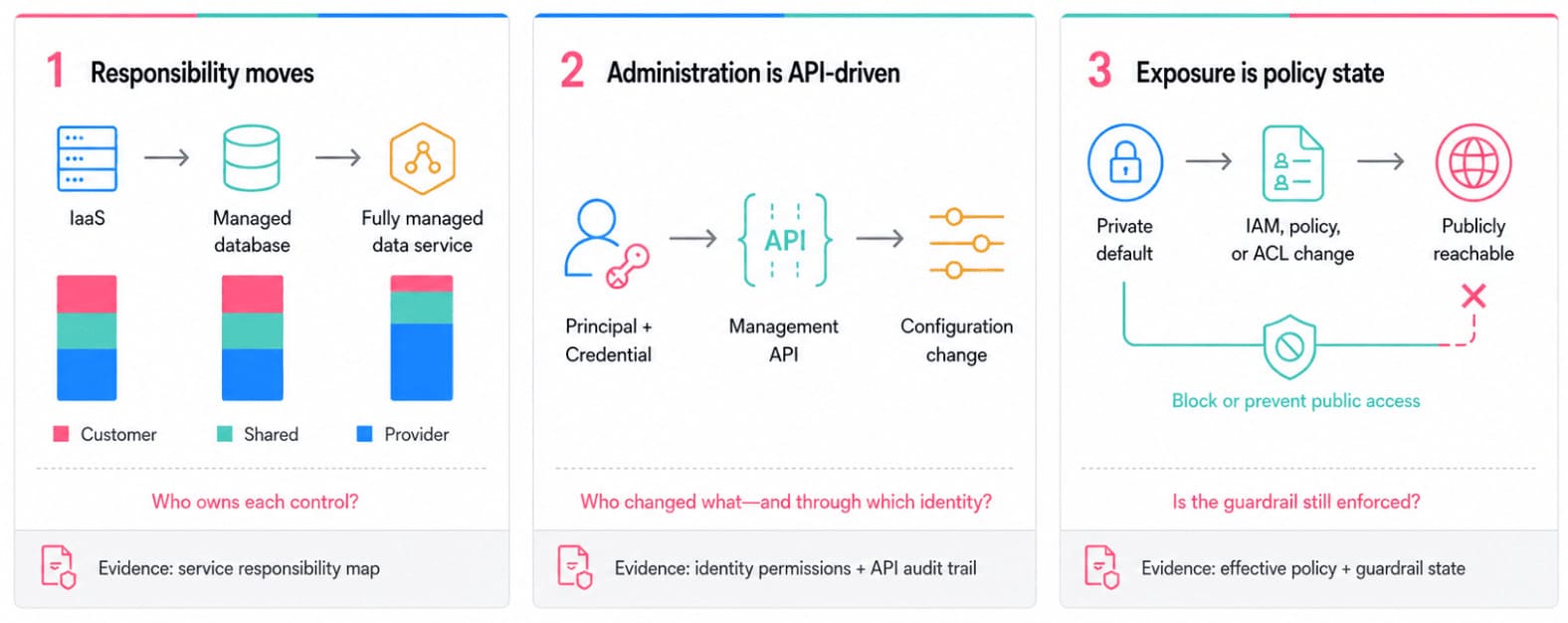
1. The shared-responsibility line runs through the middle of your controls
AWS states that customer responsibility changes with the selected service, while Microsoft maps the shift across IaaS, PaaS, and SaaS. Google Cloud’s shared-fate model builds on shared responsibility rather than removing it.
At the IaaS end, Amazon EC2, Azure Virtual Machines, and Compute Engine leave the operating system and workload with the customer. Amazon RDS, Azure SQL Database, and Cloud SQL move operating-system and platform work to the provider. DynamoDB, Azure Cosmos DB, and BigQuery shift the line again, while data classification and customer-configured access remain customer concerns.
Do not copy one generic “cloud” control set across those service classes. For each data-holding service, record the provider-operated layers, customer-operated layers, shared controls, evidence source, control owner, and exception owner. A control without a named side of the responsibility boundary is an assumption, not coverage.
2. The control plane is an API endpoint that is commonly internet-reachable
Reachable does not mean unauthenticated. It means the management surface is no longer bounded by physical access to a data center or by proximity to the workload network. An authenticated Azure Resource Manager REST call, for example, can create or delete a storage account through management.azure.com.
Review the permission path as a transaction: Principal, credential, action, resource scope, conditions, session source, and recorded event. If an application’s deployment role can widen a production bucket policy, change replication, or delete an unrelated data store, its authorization scope is wrong.
Apply least privilege, governed attribute conditions, and organization-level guardrails. The cloud security threats guide covers adjacent credential, API, and account-hijacking paths. Architecturally, require a constrained identity path, a usable audit record, and alerts for new role assumptions, impossible-travel sign-ins, or unusual storage access.
3. Object storage is one misconfiguration away from public exposure unless a higher-level guardrail blocks it
A private bucket at creation tells you how it started. For a public cloud data security review, check which guardrail blocks anonymous access now and where the setting is enforced. Use an approved test object with synthetic data.
| Storage service | Control to inspect | Evidence to retain |
|---|---|---|
| Amazon S3 | Check S3 Block Public Access at the applicable organization, account, bucket, and access-point levels. Inspect the policy or ACL behind the finding | Bucket and account identifiers, effective settings and scope, relevant policy or ACL, anonymous test result, and timestamp |
| Azure Blob Storage | Check whether the storage account allows anonymous blob access. If it does, inspect the container's access level. Also check whether static website hosting is enabled | Storage account and container IDs, account-level setting, container access level, static website state, unauthenticated test result, and timestamp |
| Google Cloud Storage | Check whether Public Access Prevention is enforced on the bucket or inherited from the project, folder, or organization. Inspect public grants and the organization-policy source | Bucket ID, effective setting and policy source, public grants, anonymous test result, and timestamp |
First confirm that an authorized test identity can read the known object. Then repeat the request without credentials against the direct object URL and record the response without retaining the contents. Do not use a signed URL for this test because it carries delegated authorization. A wrong object path can produce a failure that says nothing about access control.
Azure has an additional edge case: Disabling anonymous blob access does not make the $web container private while the static website feature remains enabled. Test that endpoint separately.
Keep delegated access separate. Google Cloud's Public Access Prevention does not block signed URLs. Review those paths and the permissions of the signing identity under their own tests.
“Teams tend to underestimate the API control plane because it does not look like a traditional perimeter. In the public cloud, the credential becomes the boundary, and credentials leak. Mature programs narrow what each identity can change, then monitor for role assumptions and storage-access patterns that do not match normal behavior.”

These realities set the control order: Map ownership by service, constrain the administrative path, and keep testing effective storage exposure.
The controls that actually matter for data security in public cloud
Public-cloud data controls work as a four-layer stack: Governed keys, data-layer authorization, private reachability, and continuous posture evaluation. Apply them in that order. Encryption cannot stop an authorized read; network isolation cannot fix overbroad decryption rights.
Treat encryption as key governance
Amazon S3, Azure Storage, and Google Cloud Storage encrypt data at rest by default. For regulated data, inspect who can create, use, disable, or destroy each customer-managed key and which datasets depend on it. Record the key ID, administrators, workload identities, rotation rule, and audit source in AWS KMS, Azure Key Vault, or Google Cloud KMS. Use BYOK or external key stores only when custody requirements justify the recovery burden.
For workloads that require a single-tenant HSM validated to FIPS 140 Level 3, AWS CloudHSM clusters can back a custom AWS KMS key store.
In Azure, use Key Vault Managed HSM for services such as Azure Storage that support customer-managed keys. Azure Cloud HSM is a separate IaaS-only option for applications that need direct HSM access, including PKCS#11 workloads. It can support migration from Azure Dedicated HSM, but it does not integrate with Azure PaaS or SaaS services.
Enforce access at the data layer
Bucket or resource policies, role-based access control (RBAC) conditions, and attribute-based access control (ABAC) should evaluate each request against the resource. Keep intent stable while provider syntax varies: A Clearance=restricted session may read a DataSensitivity=restricted object; missing sensitivity fails closed.
Test both paths and document services that cannot evaluate the attributes.
Make private reachability a tested state
For Amazon S3, choose a gateway VPC endpoint or AWS PrivateLink interface endpoint based on the source network. Use Azure Private Endpoint for Azure Storage and Private Service Connect for Google APIs.
Test DNS from approved and unapproved networks, then restrict public endpoints and egress. Creating an Azure private endpoint does not automatically disable the storage account's public endpoint. Configure the storage firewall or public network access setting separately.
This limits where leaked credentials work; it does not narrow access permissions.
Make CIS posture checks continuous
Evaluate the CIS Amazon Web Services Foundations Benchmark, CIS Microsoft Azure Foundations Benchmark, and CIS Google Cloud Platform Foundations Benchmark through cloud security posture management (CSPM), each against its matching account scope. These are account-level baselines, not complete data-service coverage.
Every finding needs the resource, failed rule, owner, exception, first-seen time, ticket, and last evaluation. Close it only after the control passes again. Owner-routed retesting is the operating floor for public cloud data security.
Read also: Multi-Cloud Governance Scorecard
One dashboard across every public cloud where your data lives
A multi-cloud public cloud data security review needs one asset cohort for shared ownership and scope while retaining provider-native evidence. By the third console, the team is translating resource types, ownership fields, and policy results by hand. Running another isolated scan does not fix that translation work.
The review needs one asset cohort with shared application, environment, owner, and compliance-scope fields while native evidence stays visible. Cloudaware carries that model into the next two workflows through normalized CMDB inventory and CSPM evaluations across configured AWS, Azure, GCP, Oracle, and Alibaba connections.
Normalized asset graph across AWS, Azure, GCP, Oracle, and Alibaba
A normalized asset graph earns its name when one PCI query works across AWS, Azure, GCP, Oracle, and Alibaba. If that query still needs five rewrites, the model is provider-shaped. Normalize Application, Environment, Owner, and Compliance Scope. Keep native type, source scope, region, resource ID, and original tags.
Reconciliation is where the model breaks. An Amazon S3 bucket arrives as env=prod; an Azure Blob Storage container uses Environment=Production. Both map to Production. Then the service catalog calls the container Test. The latest value is not a rule, so the CMDB team must define the authoritative source and flag the mismatch.
Once that rule exists, a CMDB administrator can use Cloudaware CMDB to search supported inventory across the five providers with Environment = Production and Compliance Scope = PCI. The result separates records ready for policy evaluation from blank owners and classification conflicts that need repair.
Before trusting a cross-cloud inventory query, inspect the relationships behind a representative resource. The example below connects a GCP instance to its application service, network, database, and policy context.
GCP resource relationships
Cloudaware CMDB Navigator. Related CIs connect a cloud resource to application ownership, environment, and supporting infrastructure.
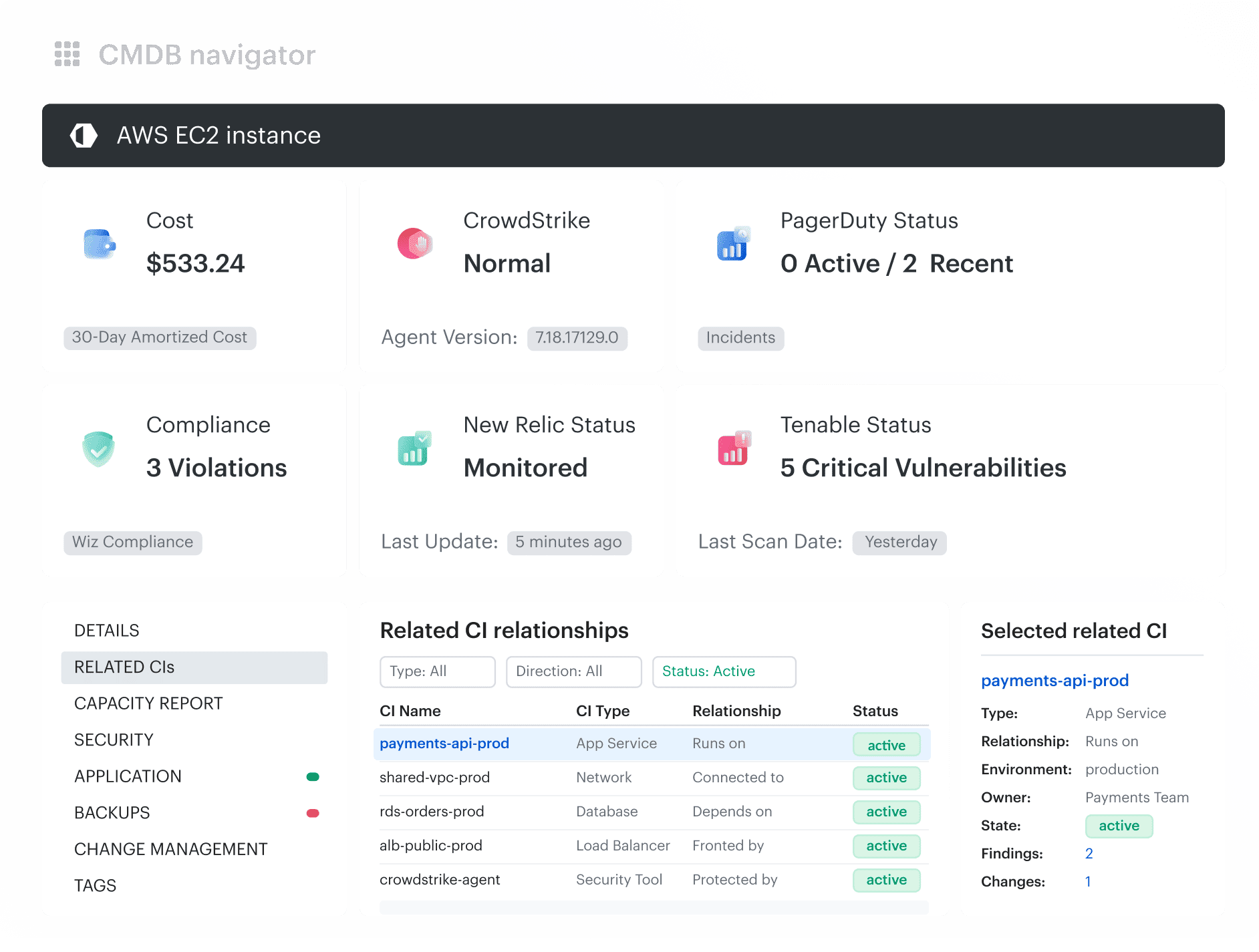
Clean rows prove little. Check the blank Owner, competing Environment values, and provider connection health. Blank or conflicting records are not policy-ready. Unsupported resource types and missing CMDB relationships reduce coverage; an empty result does not prove an empty estate.
Continuous CSPM against CIS Foundations for every cloud
Continuous CSPM reruns the correct provider benchmark after a successful inventory sync and keeps a failed check open until a later evaluation passes. It is not live polling of every cloud API.
Each provider still needs its own policy logic: The CIS Amazon Web Services Foundations Benchmark, CIS Microsoft Azure Foundations Benchmark, and CIS Google Cloud Platform Foundations Benchmark. CIS describes these benchmarks as account-level starting points. A green scorecard cannot prove that every storage or database control is secure.
The example below shows two provider-specific findings. A rule ID names the gap but cannot route it; the compliance manager still needs application, environment, owner, exception, SLA, and ticket state.
Once the CMDB records carry those fields, Cloudaware CSPM runs scheduled policy evaluations and exposes findings with ownership and remediation context. The example below shows an encryption policy applied to production storage, including failed checks, exceptions, assigned tickets, and retest status.
Storage encryption policy evaluation
Storage encryption policy review. Findings are linked to asset owners and remediation tickets, with retest status available to verify closure.
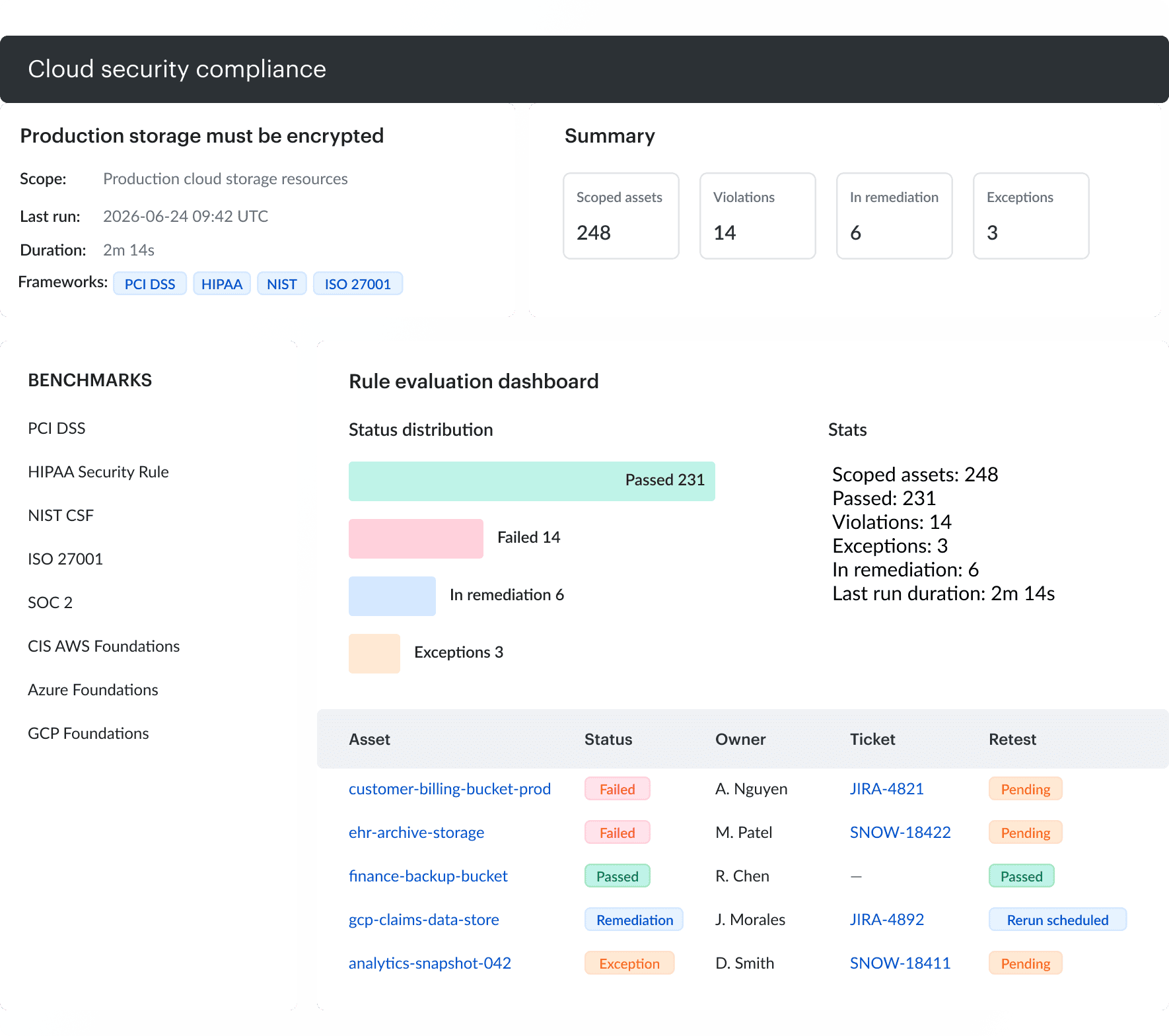
A useful reconciliation check is to filter for Ticket status = Resolved and Policy result = Failed. Rerun after the next successful sync; keep the finding open unless it passes. A closed ticket is not proof of a passing control.
Track failed syncs and unsupported resource types as unassessed coverage gaps, not passing checks.