


A FinOps framework does not fail because a team forgot the three phases. It fails when nobody can answer four operational questions: Which spend is in scope? Who owns the decision? Which capability needs to improve next? What evidence will prove that it worked?
The 2026 FinOps Framework gives teams a common operating model for those decisions. It covers principles, scopes, personas, domains and capabilities, phases, maturity, and technology categories. The model is flexible by design. You do not need every capability at Run. You need the right capability at the maturity level the current business risk justifies.
The useful work begins after the framework diagram. This guide follows the decisions teams must make, covers the 2026 changes, and fixes five patterns that derail enterprise programs. Those patterns include vague scopes, savings detached from product outcomes, uniform maturity targets, sustainability data without accountable decisions, and commitments made without usage evidence. Public cloud remains a major technology category. The current model also covers SaaS, AI, data platforms, licenses, private cloud, and data centers.
What is the FinOps Framework?
The FinOps Framework is the operating model maintained by the FinOps Foundation for establishing and improving a FinOps practice. FinOps is “an operational framework and cultural practice which maximizes the business value of technology.” The rest of the definition makes the operating expectation clear: teams use timely data and shared financial accountability to make decisions across engineering, finance, and business.
The framework works as a set of building blocks. Teams combine them around a defined decision; there is no installation sequence. A scope sets the spend boundary and business objective. Personas establish who participates. Domains describe outcomes, while capabilities specify the work. Phases provide the recurring operating cadence. Maturity tells you how far a capability must progress for the current scope. Technology categories describe the economic model behind the spend.
The FinOps Foundation Framework is flexible and non-prescriptive. A blocked business decision is a useful starting point. An incomplete maturity poster is not.
The framework in one page
| Component | Decision it should resolve | Evidence to keep |
|---|---|---|
| Principles | Which behavior should guide a cost, speed, quality, or risk tradeoff? | Decision record and named accountability. |
| Scopes | Which spend, business construct, objective, and period are in this review? | Inclusions, exclusions, baseline, owner, cadence. |
| Personas | Who decides, contributes data, approves action, and receives the result? | Decision rights or RACI. |
| Domains and capabilities | Which outcome is weak, and what work will improve it? | KPI, backlog item, data requirement, owner. |
| Phases | How will the team move from evidence to option to approved action? | Inform, Optimize, Operate review cadence. |
| Maturity | How capable must this scope become now? | Current state, target state, gap, review date. |
| Technology categories | Which usage, pricing, contract, and allocation model applies? | Source system, unit, allocation rule, commitment terms. |
How to use it without building a poster nobody operates
Pick one scope tied to a decision. “All cloud” is not a useful starting point. “Shared production platform cost allocated to three product groups before monthly close” is.
Next, select the capability whose evidence is broken. If 18 percent of the scope is unallocated, improve Allocation before asking Forecasting to explain the future. If ownership is sound but spend changes reach finance after close, Anomaly Management may deserve the next cycle. The percentage here is an illustrative operating example, not a benchmark.
Set a target maturity for that capability only. Name the owner, the success measure, and the date of the next review. Then run the phases as a loop: Inform validates the data, Optimize compares options, and Operate approves, routes, and measures the chosen action.
In the allocation example, the first success measure is not savings. It is the share of spend assigned through documented rules and reconciled to the billing baseline. Once that holds for two closes, the team has a stronger base for forecasting or unit economics. For a deeper phase workflow, use the FinOps lifecycle guide.
What changed in the FinOps Framework in 2026
The 2026 Framework update moved FinOps further from cloud cost reporting toward technology value management. The practical change is not a larger taxonomy. It is a wider decision boundary.
Executive Strategy Alignment is now a capability in Manage the FinOps Practice. Several capability names also changed so the work applies across technology categories, not only public cloud.
| Before | Framework 2026 | Why the change matters in practice |
|---|---|---|
| No dedicated capability | Executive Strategy Alignment | Connect technology value, investment choices, product priorities, and executive decisions. |
| Workload Optimization | Usage Optimization | Covers usage decisions across cloud, SaaS, AI, licenses, and other categories. |
| Policy and Governance | Governance, Policy and Risk | Makes risk and intersecting disciplines explicit. |
| FinOps Tools and Services | Automation, Tools and Services | Separates automation, platform capability, and professional services. |
| Benchmarking | KPI and Benchmarking | Requires KPIs to fit the scope and its business context. |
| Architecting for Cloud | Architecting and Workload Placement | Moves placement and value tradeoffs earlier in design. |
| Cloud Sustainability | Sustainability | Extends measurement beyond public cloud and requires clearer boundaries. |
Scopes and technology categories now need separate treatment. A technology category describes the economic model, such as public cloud, SaaS, AI, a data platform, private cloud, licenses, or a data center. A scope is the segment of spend and the business objective under review. One category can appear in several scopes. One scope can include several categories.
Do not create a scope for every category. Create one when a decision needs its own owner, success measure, or cadence. An AI inference product may need cost per 1,000 requests, model, environment, and a product owner. A SaaS renewal scope needs entitled seats, active use, contract dates, and a procurement owner. They can share the same principles while using different data and maturity targets.
Before the next framework review, write down six things: the business objective, the scope boundary, the accountable owner, the capability under review, the current and target maturity, and the next decision date. If one of those is missing, the dashboard is reporting activity rather than operating the framework.
The component changes are current. Those implementation failures are not. Five sections below show where teams usually lose the operating thread and what to repair without rebuilding the entire practice.
Mistake #1: Treating FinOps as a “cloud-only” discipline when business strategy spans beyond
Way too many teams still treat FinOps like it’s just a cloud cost optimization side project for IT. They’re busy rightsizing EC2, tuning Azure RIs, maybe chasing a few GCP anomalies — meanwhile the business is expecting a full view that includes SaaS, on-prem licenses, even your new AI experiments. And because no one sets up proper scopes, huge expenses slip right through the cracks.
The failure usually appears in the rollup. A cloud team reports a real infrastructure saving while total technology spend still rises because SaaS, licenses, or AI commitments sit outside the same decision process. The saving is valid. The scope is incomplete.
How to fix it with Cloudaware:
✅ Define one scope around a decision. Record the business objective, included technology categories, excluded cost, baseline period, owner, review cadence, and success measure.
✅ Match KPIs and owners. Maybe your FinOps team runs RI optimization, ITAM tracks shelfware, and security handles compliance exposure — all with tailored metrics.
✅ Reconcile supported sources before combining them. Cloudaware can centralize supported provider billing and usage data, then enrich it with normalized tags and CMDB context. Add SaaS or licensing data only through a verified source and an agreed mapping rule.
✅ Publish the decision view. Finance needs the reconciled total, engineering needs the resource and service path, and each application owner needs the amount they can influence.
Because honestly? That’s how top FinOps teams keep finance happy, IT focused, and the whole business steering toward actual growth — without ugly last-minute surprises. And yeah, it means you can walk into your next exec review calm, knowing you’ve got the full picture covered.
Mistake #2: Optimizing costs without aligning to product or revenue goals
Here is how it goes: your team’s crushing it on classic FinOps targets. You’ve got RI coverage dialed in across AWS, tuned Azure savings plans to near perfection, your dashboards show a beautiful drop in blended compute rates.
Finance is thrilled.
But then your product team quietly pushes back two launches because the environments they needed to be got downsized out of existence.
That’s the trap: optimizing costs without aligning to product or revenue goals.
Cost reduction is not the same as business value. A rightsizing action can lower infrastructure spend and still be a poor decision if it breaches a latency objective, delays a launch, or shifts cost into another service. Review each material opportunity against an owner, an SLO, and a unit-economic measure before calling it a saving.
So how do you keep from falling into this? Here’s how smart teams are fixing it right now, using Cloudaware:
✅ Map scopes to product lines. Use Cloudaware to break out spend by core SaaS platform, customer-facing APIs, internal ML projects, even separate out innovation labs. This way, your optimization scopes tie directly to business lines.
✅ Track effective cost per outcome. Don’t stop at CPU or storage graphs. Build dashboards that show the cost to deliver each feature, or run per-customer workloads. Let finance and product see exactly what they’re funding.
✅ Add service constraints before approval. Record the SLO, capacity floor, release dependency, and rollback path for each material opportunity. Route the candidate to the owner who can approve the trade-off. The evidence supports the decision; it does not make it.
✅ Get everyone the same view. Push these dashboards to your CFO, your product leads, your engineering directors. So the next time they debate roadmap priorities, you’ve got crystal-clear data showing how usage, cost, and customer impact all connect.
Because that’s what modern FinOps is about — using the framework to optimize spend, yes, but always in lockstep with what drives revenue, customer success, and long-term margins. That’s how you go from being the “cost police” to being the strategic powerhouse in the room. And trust me, that’s a story your whole exec team wants to keep hearing.
Read also: Cloud Cost Optimization Framework: 11 Steps to reducing spend in 2026
Mistake #3: Using one-size-fits-all maturity targets across scopes and domains
You’ve probably been there. Your AWS anomaly detection is running like a dream. You’ve tuned EC2 and RI optimization so well your finance team practically cheers. But over on the SaaS side? Your seat licenses are still managed in spreadsheets, shelfware is hiding everywhere, and your on-prem usage isn’t even mapped to products or BUs.
Meanwhile, leadership’s asking: “Why aren’t we automating all this equally? Shouldn’t we be at the same maturity for every scope?”
That’s the trap. Too many organizations try to force identical maturity targets across all domains in their cloud FinOps framework. They push for the same “run” level processes — automated chargebacks, anomaly alerts, detailed forecasts — on cloud, SaaS, on-prem, and AI, all at once.
It sounds clean. It looks beautiful in a slide deck. But in reality? It’s a recipe for diluted focus and wasted cycles.
The framework is intentionally non-prescriptive. Maturity belongs to a capability within a scope, not to the organization as a single badge. Allocation may need to reach Run for a shared platform while SaaS forecasting stays at Crawl until usage and contract data are reliable.
So what’s the move? Here’s exactly how top teams fix it with Cloudaware:
- Create a scope-capability matrix with four fields: current evidence, current maturity, target maturity, and the next decision. One maturity label for the entire organization hides the gap.
- Consider an illustrative operating case. A shared cloud platform has 18 percent unallocated spend, and Allocation is at Walk. The next target is an exception queue below 5 percent for two monthly closes. The FinOps lead owns the rule set; application owners resolve unmatched spend each week.
- Cloudaware can supply billing, allocation, forecast, anomaly, and optimization evidence for supported sources. The maturity assessment belongs in the operating review. The platform exposes evidence. The practice decides what Run means for this scope.
- Revisit the target when the business objective changes. A new provider, acquisition, product, or pricing model can break the previous data path. Re-scoping is the correct response, not evidence that the program failed.
Because that’s what real financial management under a FinOps framework looks like. You allocate your resources, time, and automation where they actually protect margins and delivery. Not chasing the same fancy anomaly detection everywhere just for symmetry.
That’s the story you want at your next review. Your teams are driving smarter decisions, reducing cloud cost, cleaning up SaaS waste, tightening on-prem compliance — each at the right pace. Perfectly tied back to your business goals. That’s how you build trust, hit targets, and keep your FinOps practice from turning into a one-size-fits-none circus.
Mistake #4: Ignoring sustainability or ESG cost accountability in tech financial strategy
You’ve got your cloud cost strategy humming. Your AWS blended rates are down, Azure RI coverage is sitting at 80%, GCP anomaly detection is flagging spend spikes before they balloon. Meanwhile, your DevOps team is busy running usage cleanups on Kubernetes clusters, and your ITAM folks are auditing on-prem licensing compliance. Feels like the FinOps framework dream, right?
But then the board meeting hits. Suddenly, your CFO is side-eyeing you while your Chief Sustainability Officer is asking, “Great that we’re cutting costs, but what’s our actual carbon impact this quarter? How does this align to our ESG targets tied to financing?”
Sustainability belongs in the 2026 framework as a capability, but carbon and cost are different measures. A cost dashboard cannot infer defensible emissions on its own. The team needs an agreed emissions source, allocation method, reporting boundary, and owner before it can connect technology decisions to an ESG target.
If your dashboards and FinOps metrics can’t tie spend to carbon impact, your next audit — or investor pitch — is already on shaky ground.
So how do you fix it, without drowning under even more reporting chaos? Here’s exactly how smart teams are doing it in Cloudaware:
Choose the decision before building an ESG dashboard. Workload placement, hardware refresh, a utilization policy, and a supplier review require different emissions measures and boundaries.
Use an authoritative emissions source and document the method. Record whether it covers operational carbon, embodied carbon, or both. Region, period, allocation basis, and uncertainty belong beside the number. Cost and carbon can move in different directions.
Connect that measure to accountable technology context. Cloudaware can contribute supported billing, usage, asset, service, and owner relationships. It is not the emissions authority unless the implementation has a verified source and method.
Review financial value, service constraints, and sustainability impact in the same approval record. That keeps the result auditable without pretending that one blended score settles every trade-off.
Because that’s what modern FinOps is evolving into. It’s not just about brilliant cost optimization. It’s building a framework where your financial strategy and sustainability goals drive the same decisions.
Read also: 10 Steps to IT Asset Management Strategy For Multi Cloud Setup
Mistake #5: Failing to embed FinOps into vendor, licensing, and AI procurement decisions
Here’s the problem. You’ve got your cloud environment under control. EC2 rightsizing is driving down waste, Azure Savings Plans are hitting sweet spot coverage, your SaaS seat allocations are finally mapped by BU. You’re running a slick FinOps process — tracking usage, tagging for chargebacks, pushing daily anomaly alerts.
But then finance comes along and locks in a multi-year AI licensing agreement based on aggressive sales pitches or high-level product ambitions. No one pulled your real data. Procurement renews a SaaS contract at peak headcount assumptions — ignoring the shelfware your dashboards have been flagging for six months.
That’s what happens when you fail to embed FinOps into vendor, licensing, and AI procurement decisions. It’s like optimizing your framework everywhere else, only to let giant cost commitments slide through with zero guardrails.
The risk sits in the commitment gap: procurement buys a future capacity level, while usage and product plans change underneath it. Before signature or renewal, compare the contract baseline with current consumption, forecast range, ramp assumptions, and exit terms. Record who accepts the downside if demand lands below plan.
So how do you fix it — in real, day-to-day steps your teams can use right now?
✅ Make FinOps a core checkpoint in every new vendor or licensing conversation. Before your CFO signs that next AI GPU deal or a three-year SaaS renewal, feed them real usage and forecast data from your Cloudaware dashboards. Show actual workloads, growth rates, and even recent rightsizing gains that lower their baseline needs.
✅ Build the commercial scenarios in the approved finance or procurement process. Use supported usage, allocation, budget, forecast, and commitment evidence from Cloudaware as inputs. Keep the baseline, ramp assumptions, renewal date, and downside owner beside the decision.
✅ Recheck the contract assumptions before the renewal window closes. Compare the agreed demand baseline with actual consumption and realized product demand. Procurement owns the commercial action; FinOps maintains the evidence trail.
✅ Share unified dashboards with all stakeholders. Bring procurement, finance, and engineering into the same truth. Let them see how licensing, reserved commit utilization, and on-prem resources all align to workloads and business goals.
Because that’s what a mature FinOps framework looks like. It doesn’t stop at usage-based optimization inside IT. It extends the same financial discipline to every decision — vendor contracts, multi-year licensing, GPU procurement — before someone locks in a commitment that buries your cloud cost wins.
And honestly? That’s how you go from being seen as the team that polices budgets to the strategic powerhouse keeping margins tight, growth predictable, and every vendor promise aligned to actual data. That’s the story you want to tell at your next exec review — and the one that builds trust across every corner of the business.
Where Cloudaware fits in a FinOps operating model
A FinOps platform cannot decide whether a product team should accept a commitment, delay a change, or protect capacity. It can make that decision traceable. The analyst needs reconciled cost, the service path, the accountable owner, the constraint, and the approval state in one review flow.
For supported sources, Cloudaware FinOps centralizes provider billing and usage data, combines it with normalized tags and CMDB service context, and supports allocation, showback and chargeback views, budgets, forecasts, anomaly review, optimization opportunities, and reporting.
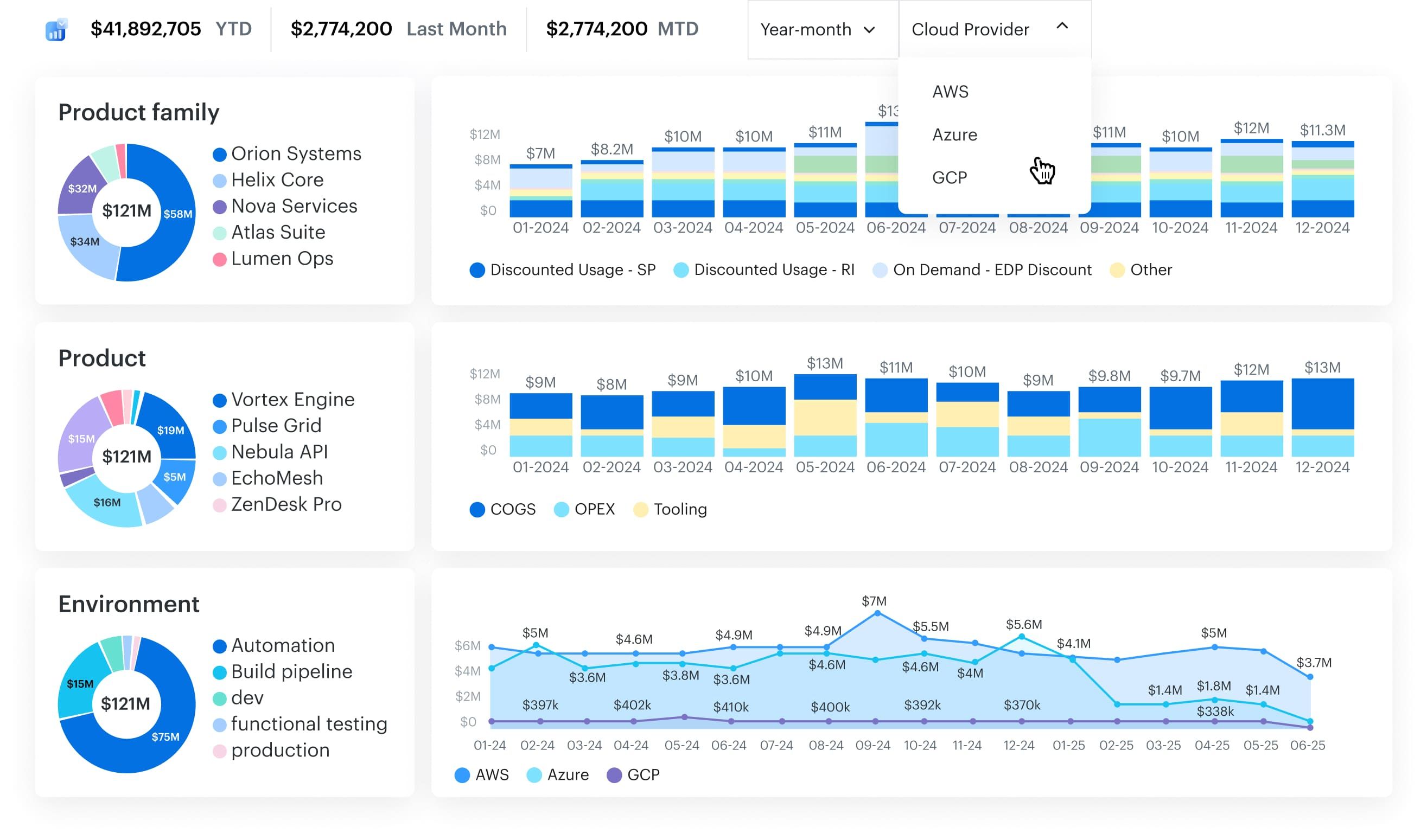
Cloudaware FinOps view for tracing a cost record to its application, owner, and allocation logic before routing a decision.
- Ingest supported billing and usage sources, then monitor data freshness and completeness.
- Normalize business context with tags, applications, services, owners, teams, business units, or cost centers.
- Apply direct and shared-cost allocation rules. Reconcile the result to the agreed billing baseline.
- Review budgets, forecasts, anomalies, commitments, and optimization opportunities for the same scope.
- Route the decision to the accountable owner. Approve, reject, schedule, or implement the action in the appropriate system.
Potential savings remain potential until an owner approves a change or a supported automation executes it. Provider billing remains the financial source. Cloudaware allocation and Effective Cost views are decision layers built from the available billing data and configured rules.
Bring one hard scope to the demo
Use a sample with shared cost, incomplete tags, and one named owner. Test reconciliation, allocation traceability, forecast assumptions, anomaly workflow, and the handoff to action. A clean feature tour is less useful than one broken decision path.